Back to Footers
Inspired by:Jolocky
Added on Oct 5, 2026
Pixel Foundry Specimen
pixel-foundry
Kinetic & Canvas Architecture
Built from scratch by Jolocky, with our own layout, color and motion.
Signature Standard
Precision interaction engineering with zero external runtime bloat.
Open Source Registry
Production-ready multi-file tree built for modern Next.js and Tailwind CSS.
Engineering Breakdown
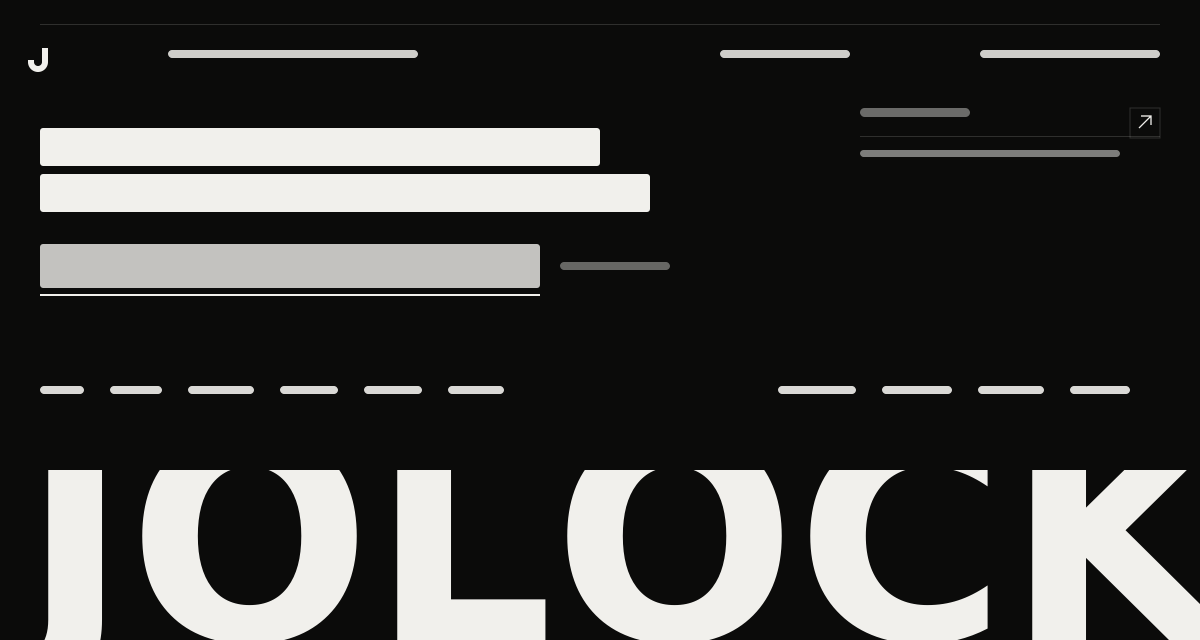
Pixel Foundry Specimen — A quiet monospaced footer for a type foundry, ending in a huge wordmark built from rounded pixel blocks on a canvas. The blocks assemble one by one when it scrolls into view, and a click builds it again. Move the cursor or drag a finger near it and the blocks break apart into separate pixels with a faint grid underneath. Hover or focus a typeface in the list and the whole wordmark morphs into that cut, whether it is studded, wobbly, dripping or fat. Above it sit a live clock for the studio's city and a status that rotates every few seconds and scrambles in, followed by link lists that turn into ruled rows with numbers on mobile.
Every interaction state, motion curve, and responsive edge-case has been extracted and reconstructed for seamless integration into modern React applications.
01
Zero — Primitive Dependency & Pure Standalone Pattern: pure React, scoped CSS and one canvas. There is no UI primitive library, no animation library, no image files and nothing extra to install.
02
Pixel Wordmark: the letters are 6 by 12 cell shapes laid out on a grid. Settled neighbouring cells merge into solid shapes with rounded outer corners, and empty inner corners are filled with a curve so the letters flow into each other.
03
Build Block by Block: when 30% of the canvas is visible, or after 2.5 seconds anyway, every cell fades in over 300ms. The delay grows with the column and row plus a little scatter, so the word builds from the top left. Clicking replays it.
04
Pointer Breaks the Blocks: cells near the cursor, or a dragging finger, ease away from the solid shape into rounded single pixels that are pushed outward, and a small grid dot appears in the empty cells they leave.
05
Four Typeface Cuts: Petak adds studs between letters, Kelok shifts the rows into a wobble, Lontong drips cells down and Gembul thickens every stroke by one cell. Hovering, focusing or touching a typeface morphs the art with a short stagger, and leaving the list returns to Petak.
06
Live Clock Without Mismatch: the studio's local time ticks every second from the Intl time formatter. The server render shows dashes so hydration always matches.
07
Rotating Status: every 3.6 seconds a new status scrambles in over nine 40ms frames. Letters settle from the left, spaces stay, and a square keeps blinking next to it. With reduced motion it switches at once.
08
Two Cell Shapes: on mobile the art is mounted again with taller cells, 2.6 times their width instead of 1.25, so it keeps its height in a narrow screen.
09
Three Layouts: desktop puts the meta on the left and three link columns from 53% across. Tablet adds a Back to top link and hides the country. Mobile makes ruled rows of 44px with numbers at the right, lists the outside links in one row and adds a copyright row with a short Top link.
10
Reduced Motion: the art appears at once, the status does not scramble, and the square stops blinking.
Technology Stack
Engineered using established and reliable modern web technologies for peak runtime performance and developer ergonomics.
React
Next.js
TypeScript
Scoped CSS
HTML Canvas
Inline SVG
Zero Primitive
Last Updated
Oct 5, 2026
Tags & Specifications
Pixel WordmarkCanvas ArtTypeface MorphLive ClockStatus ScrambleZero Primitive
Color Palette
#efeeeb
#262626
Technology Stack
Engineered using established and reliable modern web technologies for peak runtime performance and developer ergonomics.
React
Next.js
TypeScript
Scoped CSS
HTML Canvas
Inline SVG
Zero Primitive